

Local questions, useful answers.
7 researched entries from the original guide, with original source references preserved. Open a question to see its answer.
HistoryHow did Zionsville begin?Best starting point
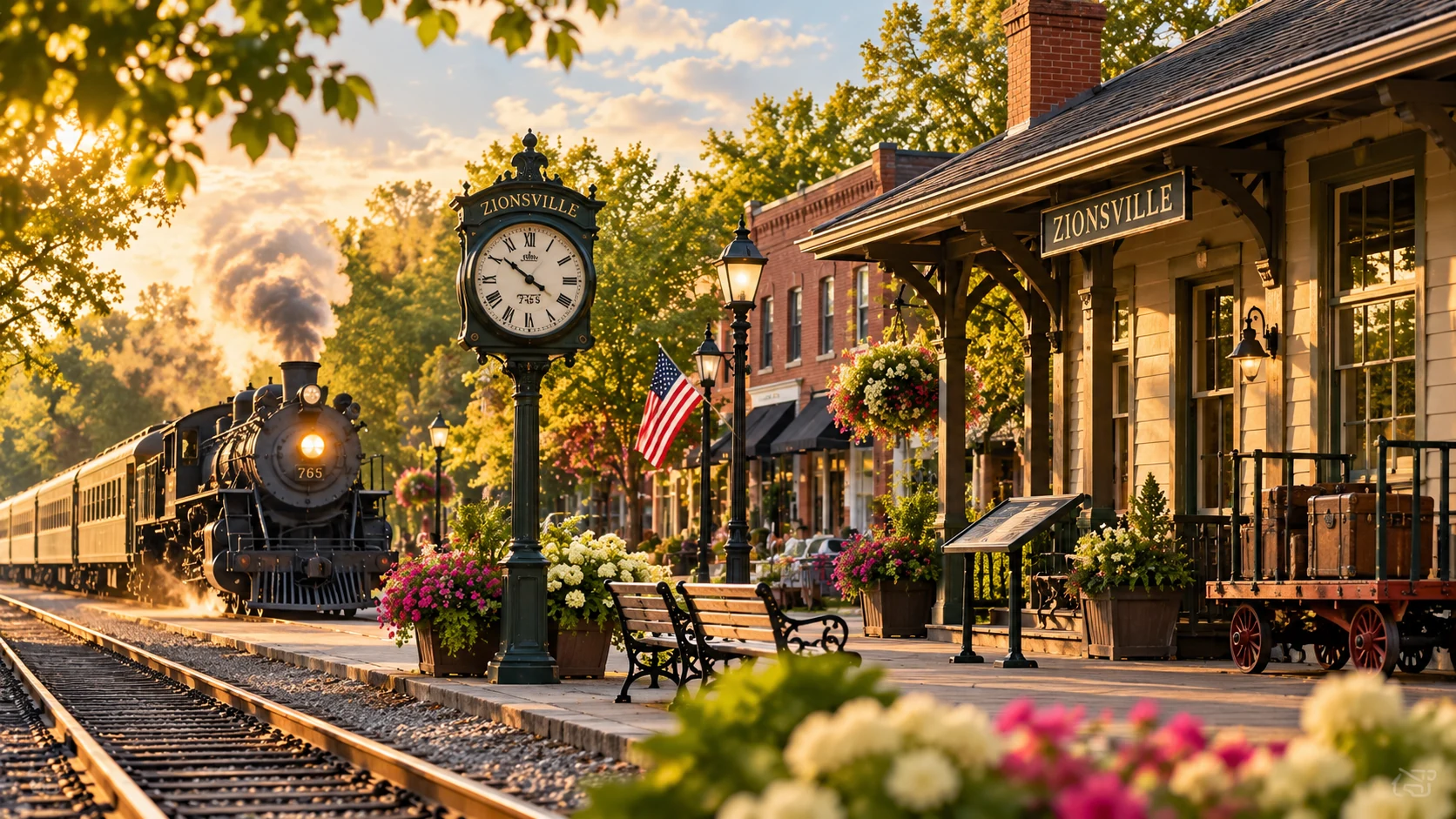
Zionsville began as a railroad town. William Zion, a Lebanon businessman and railroad director, worked with landowners Elijah and Mary Cross to establish a station and town on the Cross property. Boone County surveyor James Mullikin prepared the original plat on November 5, 1851; it was formally filed on January 26, 1852.
The documented naming account says Elijah Cross first considered Marysville in honor of his wife, then Zion’s Village, before the name became Zionsville.
The Encyclopedia of Indianapolis records the next early milestones: a first church in 1854, first school in 1858, the Zionsville Times in 1860 and incorporation in 1866.
Reviewed July 16, 2026
HistoryWhat role did the railroad play in Zionsville’s history?
The railroad explains why Zionsville was created where it was. William Zion wanted a depot between Whitestown and the Boone–Marion county line, and the town was platted around that transportation opportunity. Rail access then supported early movement, commerce and population growth.
The Town’s history identifies William Zion as a director of the Lafayette and Indianapolis Railroad and explains how he convinced Elijah Cross to establish the town on the Cross family property.
The Encyclopedia of Indianapolis places the first depot near today’s Lincoln Park. The modern Big-4 Rail Trail carries the transportation story forward, but the nineteenth-century railroad, later rail operations and today’s trail are different historical periods.
Reviewed July 16, 2026
HistoryWhy is brick Main Street important to Zionsville?
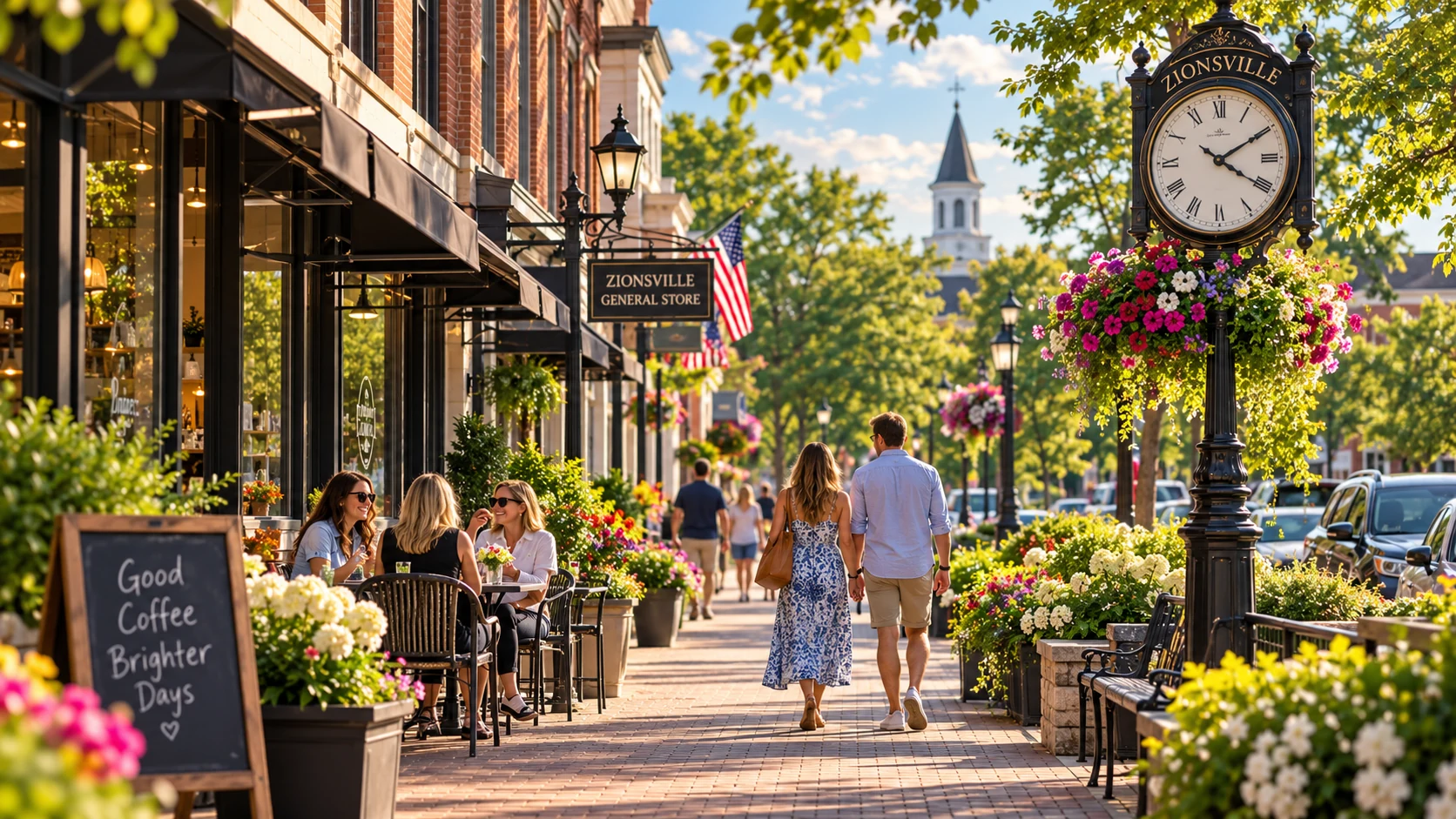
Brick Main Street is the most visible thread connecting the Village’s early commercial development with its later identity as a restored small-town destination. It is historic infrastructure, not just a decorative streetscape.
The Town describes the Brick Street as central to Zionsville’s small-town character. The Encyclopedia of Indianapolis adds that residents and the Chamber of Commerce restored many nineteenth-century cottages and promoted an early-American downtown appearance in the 1950s and 1960s.
The surrounding Village therefore reflects several layers: surviving older buildings, transportation changes, later alterations, preservation work and twentieth-century reinvestment.
Reviewed July 16, 2026
HistoryHow did the Village become the historic-looking center seen today?
The Village combines surviving older buildings with a major period of downtown reinvestment and image-making in the 1950s and 1960s. Local business and community efforts promoted an early-American appearance, restored cottages and helped turn the Village into a visitor destination.
That history matters because the Village is not a perfectly unchanged nineteenth-century scene. Its present character reflects original buildings, later alterations, preservation work, commercial reinvestment and community branding.
For a specific building, use property records and current Town planning information rather than inferring its date or legal status from appearance alone.
Reviewed July 16, 2026
HistoryWhere can I search historic photographs and records from Zionsville?
Start with the Indiana Historical Society’s digital collections for cataloged photographs, then use Hussey-Mayfield Memorial Public Library’s genealogy and online-research pages for Boone County records, newspaper databases and librarian help.
The Indiana Historical Society provides a digitized photograph of Zionsville’s Main Street from about 1875. HMMPL points researchers to the Evergreen Indiana catalog and maintains access to broader history and newspaper databases.
Each archive sets its own rules for downloading, publishing or ordering copies, so check the record page before reuse.
Reviewed July 16, 2026
HistoryWhy was Zionsville once called “The Dahlia City”?
In the 1920s, Zionsville became known as “The Dahlia City” because two local nurseries—Tudor Gardens and Parkway Gardens—were known for their dahlia gardens. The identity has since reappeared in public art and community projects.
The Town’s public-art inventory connects the dahlia history to a painted traffic-control box and the Oak Street Big-4 Rail Trail tunnel mural.
This is a useful example of how Zionsville’s history appears in today’s streetscape rather than only in an archive.
Reviewed July 16, 2026
HistoryDoes appearing historic mean a Zionsville property is legally protected?
No. Age, architectural interest, inclusion in a survey and legal protection are different things. A property may be historically documented without being subject to local preservation review, and private covenants may impose separate restrictions.
For a proposed exterior project, verify the property’s current zoning, whether it lies in a designated conservation district, whether a Certificate of Appropriateness is required and whether private covenants also apply.
The Town’s preservation ordinance establishes the local commission and review framework. Historical narratives and photographs are valuable context, but they are not permit decisions or title documents.
Preservation review, zoning and private restrictions are property- and project-specific. Confirm them before planning work.
Reviewed July 16, 2026